Safely Stash Your Bitcash In Virtual Vaults

The popularity of Bitcoin and other crypto-currencies bodes well for promoting a decentralized financial system, but their allure also ups the danger of their theft. Now, virtual vaults have been created to add an extra layer of protection to your Bit-fortune.

According to www.joh.cam.ac.uk, there are currently over 13 million Bitcoins in circulation, with a value of over £311 per unit. Though the price fluctuates, this could rise to over £1000 per unit, and over 80 million people are expected to hold Bitcoin "wallets" (online accounts of their Bit-loot) by the end of 2014. The virtual vault Elliptical, created by students from St. John's University, Cambridge, England, holds virtual "keys" for users so that their Bitcoins may be accessed with additional layers of security, while making reports available on the varying market price of the currency. The heavy security makes Elliptical an attractive option for companies, law firms, and financial service providers, including the new Global Advisors Bitcoin Investment Fund (who collaborate to make Bitcoin viable for pensions and insurance providers.)

Elliptical is fully insured, allowing users not to fret that hackers or viruses will act like modern Bit-bank robbers. Creator James Smith explained Elliptical as, “a secure, insured custodian of Bitcoin and other digital currencies, serving a range of enterprise customers." He claims the site, which recently obtained £1.2 million in funding from the Octopus group, is being placed "at the heart of digital currency infrastructure."

So if your faith in the dollar, Euro, or pound is sinking lower than your hope for humanity, perhaps its time to invest in the realm of e-riches. Other vault options, such as Coinbase and Xapo, offer similar vault services.  The scope is serious, and the security is stronger than what you may think you are currently safe with.

No cracking, no hacking.

Green Genes: Scientists Work On "Hacking" Plants

With global warming now a widely-accepted reality, it's time to make sure that our planet's plant life is able to keep up with the rising temperatures. To drought-proof the world's greenery, scientists have been experimenting on hacking plant genes to improve water retention.

According to factor-tech.com, over 2 billion people worldwide have been affected by drought in recent years. The UN's Food And Agriculture Organization reports that over 11 million people have died from drought-related issues (crop failure or unsafe water sources due to scarcity) since 1900. Now, Duke University scientists aim to curtail that trouble, having "hacked" into plant genes to tell them when to conserve the scant amounts of water some of them are only able to obtain.

The "coping methods" are triggered in the plants when their levels of calcium are raised, forcing them to process precious water more slowly. This is encoded into a gene in the plant's cell membranes. To confirm this, the scientists raised both plants with this gene and plants lacking it and studied the results. “Plants that enter drought-fighting mode quickly and then switch back to normal growth mode quickly when drought stress is gone should be able to allocate energy more efficiently toward growth,” concluded associate professor of biology Zhen-Ming Pei.

This discovery will allow scientists to assess how plants in drought-afflicted areas could be made to augment their water retention and thus thrive even under difficult circumstances.  If we can't fix global warming yet, at least we're working on how to deal with it.

Go easy on the drinking there, buddy.

Space Station Sunday: Robonaut Gets A Leg Up (Two, Actuallly)

With an imminent return to Earth scheduled for Russian cosmonauts Alexander Svortsov and Oleg Artemyev, there has been a lot of activity on the ISS this week. However, one particular development gave legs (literally) to a whole new set of ideas.

Commander Steve Swanson has been making some serious strides on the ISS's synthetic spaceman Robonaut, www.waaytv.com reports. The humanoid helper, who happens to be a robot, has long aided the ISS crew with experiments, and now thanks to Swanson's "robot surgery", Robonaut has gained a whole new range of motion. Formerly a head, torso, and two dexterous arms and hands, Robonaut now has a pair of legs to aid him in station science endeavors.

Since the ISS's microgravity keeps its residents relatively aloft, Robonaut's legs did not need to be proportionally as large as his upper body to support his weight. While comparatively small, they are extremely flexible thanks to three different jointed segments. Additionally, instead of feet, Robonaut has a pair of grasper attachments, making him useful in a variety of positions that human astronauts may not be be able to sustain (and also because come on, what badass space robot needs feet when it can have graspers?)

This frees up Robonaut to scoot around the station doing maitenance, like a cooler version of the Jetsons' Rosie the Robot, allowing the human astronauts to do the more complex scientific tasks that we went to space to work on in the first place. However, the badass 'bot will get his chance to act like one of the real boys (and girls) when he takes his first spacewalk later this year.

Watch this space!

He's got legs...and he knows how to use 'em...(and cool grasper-feet too!)


New 3-D Printed Books Let Blind Kids Read By Touch

The usage of 3-D printing to help those with physical impairments has taken many interesting paths. Recently, this technology has found another excellent use, helping blind children "read" picture books by 3-D printing in Braille.

According to newscientist.com, The Tactile Picture Books for Children Project, an initiative from the University of Colorado, aims to use 3-D printers to bring literature to life for visually-impaired youths. The printers layer the stories' images onto the pages, allowing readers to feel the pictures, which are augmented by text in Braille.

"Since our children have limited or no vision, having a book that they can feel gives them a sense of what the world looks like," says Alice Applebaum, the executive director of Denver's Anchor Center for Blind Children.

So far, 3-D titles include Goodnight Moon and The Very Hungry Caterpillar. Later this year, the Denver group will team up with Boston's National Braille Press to offer the new title Dragons Love Tacos.  Fortunately, Everybody Poops is not yet being considered for this 3-D treatment.

A detail from a 3-d printed book.  No, adults, you CANNOT request a 3-D 50 Shades Of Grey.


E-bola: Watch Virus's Developments With This App

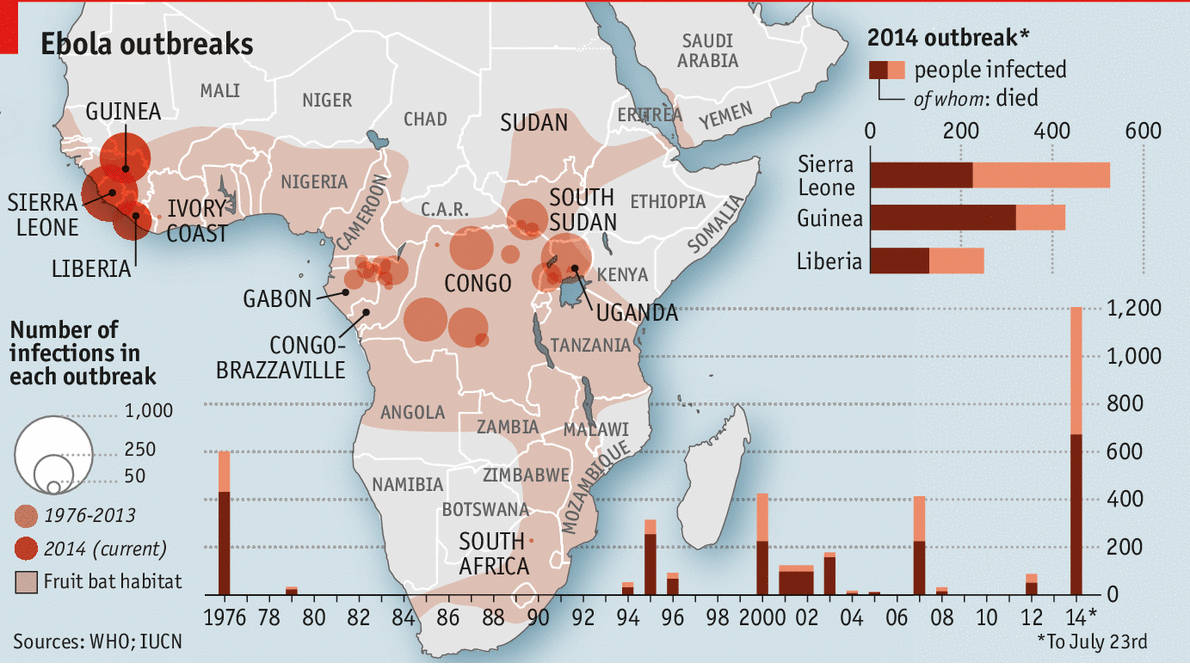
With thousands of cases and escalating confirmed deaths attributed to the Ebola virus in Africa right now, it has become important to keep tabs on the spread of disease, preferably from as far away as possible. The CDC has stepped in to help, creating a new category in their Epi Info app to help monitor the outbreak.

As reported by gcn.com, the "contact tracing" ability of the app makes it possible to deduce where certain carriers of the disease have caused it to spread, allowing for others to avoid possible danger zones. The viral hemorrhagic fever (VHF) app creates databases of crucial patient information, such as names, locations, ages, gender, and the especially important "dead or alive" status. Those classified as "sick and isolated" with no further information are also considered cases. Aid workers can then use the data to visualize and assess VHF problems.

Once downloaded, the app is functional sans internet connection, which is useful in the many remote areas in which the disease flourishes. The Epi Info app also can be used to track other epidemics, such as Marburg, Crimean-Congo, Rift Valley, and Lassa. Hopefully, the current Ebola crisis can be partially mitigated in thanks to this careful observational/informational aid, in conjunction with dedicated workers.

“The bottom line with Ebola is we know how to stop it: traditional public health,” said CDC Director Tom Frieden. “Find patients, isolate and care for them; find their contacts; educate people; and strictly follow infection control in hospitals. Do those things with meticulous care and Ebola goes away.”

Maybe head to any other continent for vacation this year.

Shut The World Up: New Window-Mounted Device Eliminates Outside Noise

Sure, you love living in the big city, but maybe you're tired of constant reggaeton music waking you up at ridiculous hours, or perhaps the hip new bar that just opened up underneath your apartment has got too many pseudo-intellectuals screaming drunk conversations at each other outside over their American Spirits. Or perhaps your landlord conveniently forgot to mention that the hospital's ambulances make frequent trips beneath your window. Want to shut out the noise without shutting yourself out of urban life? A new noise-cancelling device can help.

As reported by weburbanist.com, a new invention called Sono is now able to maintain your sanctuary with just a simple sticky dial on your window. Currently a prototype in development, according to inventor Rudolf Stefanich, it “turns your window into an advanced noise cancelling system that allows you to eliminate and/or control the sounds that pass through."

Specific sounds can be filtered out by simply turning the dial, which is essentially a volume knob for real life. The option to replace the nuisance noise with your own special soundtrack rounds out the Sono's usefulness. Correctly stating that, “In our loud and busy world a moment of silence has become a scarce and almost luxurious experience", Stefanich (an industrial designer) was motivated to help keep the peace by creating Sono's broadband antenna rings to reduce "the level of e-smog pollution" in your life.

Doesn't that sound great?

*May not be applicable during Mardi Gras.

A Drone New World: Disney To Use Flying Robots In Their "Magic"

Like them or not, no one can deny that Disney live operations are major spectacles that are specifically engineered for a maximum "wow" factor. Now, they plan to augment their man-made magic with some help from some happy little flying robot friends. Weirdest sidekick ever?

According to the nypost.com, Disney Enterprises are massing a fleet of unmanned aerial vehicles to fly around and aid with puppetry and light work in their live shows, like Cinderella or Snow White's fun forest friends (if they were electronic and had cousins with the potential to be used for evils from surveillance to assassinations.)

Similar to Jeff Bezos' notion to put drones to work as delivery vehicles, or Google's plan to make them aerial photographers (supposedly) for cartographical purposes, the masters of the Mouse feel that drones would make good "castmembers" (Disney slang for workers.) Three patents approved this week would allow the ground-controlled gizmos to manipulate puppet "tether lines" from the air, carry around portable "flexible projection screens" like flying carpets for movies, or shoot colored lights from the sky (and with Disney's penchant for fireworks, this could look amazing.)

The latter, as part of Disney's "Symphony of Lights", was quoted as being applicable for use “over a sports stadium or theme park where no or few buildings may be present.” Cue the countdown to someone using it to make a wedding proposal. While this technology is interesting and could be used well by such creative types as Disney, does this open a door for constant drone-based entertainment-whoring or flying advertisements to become part of our world?

It's the cirrrrrcle of liiiiife (and sometimes lack thereof.)